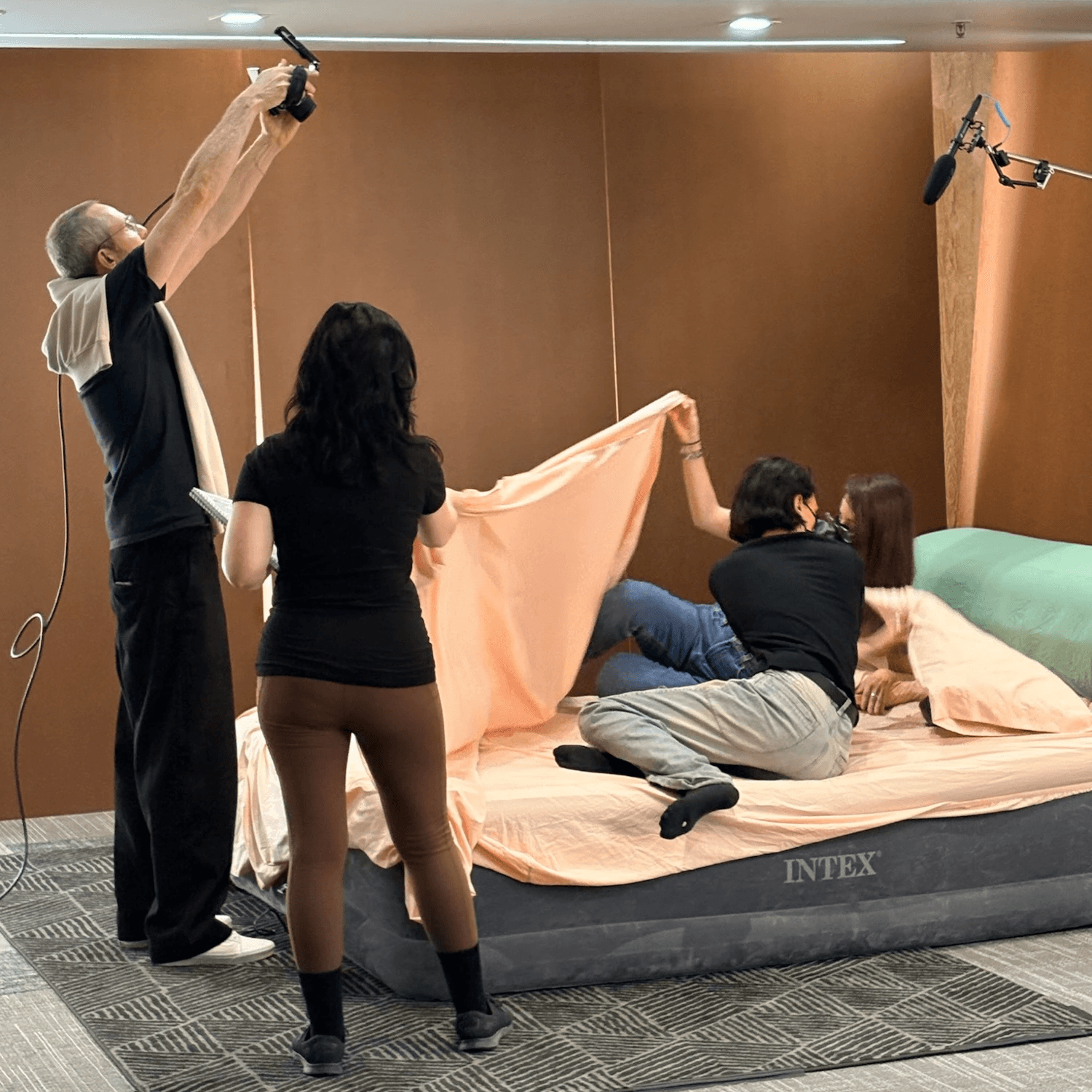
What Counts as On-Set Experience for Intimacy Coordinator Training?
One of the most common questions aspiring Intimacy Coordinators ask is also one of the most practical:
What counts as on-set experience?
It is an important question because Intimacy Coordination does not happen in theory. It happens inside the pace, pressure, hierarchy, and communication systems of film and television production.
An Intimacy Coordinator may be doing deeply performer-centered work, but they are still working on a set. That means they need to understand the structure around them. They need to know how departments communicate, how the AD team moves the day forward, how directors give notes, how performers are called to set, how wardrobe and makeup needs are handled, how schedule pressure affects decision-making, and how quickly a lack of preparation can become a problem.
You do not need to know everything before you begin training.
But you do need to understand the room you are training to support.
Quick answer
You do not need prior on-set experience to begin Module I with CINTIMA.
To access Module III, CINTIMA requires proof of 10 days of work experience on a professional film or television set within the past 10 years.
That experience can come from any department. It can be above or below the line, behind or in front of the camera, paid or unpaid, union or nonunion.
What matters is that you have had real access to a professional film or television set and can provide documentation.
Accepted proof may include call sheets, pay stubs, or a letter from a producer, UPM, or hiring department.
Why does on-set experience matter?
The on-set experience requirement exists because Intimacy Coordination is not only about understanding consent.
Consent matters. Performer advocacy matters. Trauma-informed practice matters. Movement, modesty garments, rider language, documentation, and closed-set protocols matter.
But the IC also has to know how a production works.
A film set has its own pace and structure. Information moves through specific channels. The director, ADs, producers, performers, costume, hair and makeup, camera, legal, stunts, props, locations, sound, and production office all have different needs. Sometimes those needs align. Sometimes they pull against each other.
The Intimacy Coordinator is often holding sensitive information in the middle of that system.
The director may be thinking about story, tone, and frame.
The performer may be thinking about boundaries, exposure, and trust.
The AD may be thinking about time and budget.
Costume may be thinking about modesty garments, closures, robe access, body coverage, and continuity.
Legal may be thinking about rider language and liability.
Production may be thinking about risk, cost, and schedule.
The IC has to understand how to communicate with each of those people without losing the performer-centered core of the work.
That kind of understanding is difficult to build without having been on set.
The requirement is not there to make the field harder to enter. It is there because the job itself requires production fluency.
Do you need on-set experience before starting training?
No.
CINTIMA does not require prior on-set experience to begin Module I.
That is intentional.
Many people come to Intimacy Coordination from adjacent fields. They may be actors, dancers, movement directors, choreographers, theatre artists, stunt professionals, producers, assistant directors, educators, therapists, advocates, somatic practitioners, sexuality educators, nightlife performers, or people with another body-based creative practice.
Those backgrounds can bring real value to the work.
An actor may understand what it feels like to perform vulnerable material while the room watches.
A dancer may understand repeatable movement, physical precision, and rhythm.
A producer may understand the pressure of schedule and budget.
A therapist or advocate may understand careful listening, emotional containment, and the importance of clear boundaries.
A sexuality educator may understand language around bodies, desire, power, and consent.
Those entry points matter.
But they are not the whole job.
Module I is designed for anyone to access the starting point. It gives trainees a foundation in the role, the language, the scope, and the professional expectations of Intimacy Coordination before they are expected to meet more advanced requirements.
You can begin there, learn the foundations, and decide whether this pathway is right for you.
What counts as a professional film or television set?
CINTIMA’s on-set experience requirement is focused on professional film or television work.
That generally means a set where there is a production structure, scheduled shoot days, defined roles, call sheets or equivalent documentation, and a real production environment.
Examples may include:
Feature films
Short films
Television series
Streaming productions
Commercials
Music videos
Professional web series
Independent films with formal production structure
Student films with sufficient documentation and professional set conditions
The important question is not whether the project was famous. It is whether the experience gave you real access to the set.
Did you understand call times?
Did you experience production hierarchy?
Did you see how departments communicate?
Did you work within the pace and structure of a shoot day?
Did you understand how scenes were rehearsed, blocked, shot, reset, and documented?
Did you have a role that can be verified?
That is the kind of experience the requirement is designed to capture.
What departments count?
CINTIMA’s requirement allows experience from any department, as long as that role functions within the set.
That matters because Intimacy Coordinators come from many different parts of the industry.
Your experience may count if you worked in:
Acting or performance
Directing
Producing
Assistant directing
Production office
Camera
Sound
Costume
Hair and makeup
Art department
Props
Locations
Script supervision
Stunts
Choreography or movement
Background acting
Production assistant work
Wardrobe support
Intimacy department support
Other verifiable film or television roles
The role itself does not have to be intimacy-related.
A day on set as an actor can teach you one part of production. A day on set as a PA can teach you another. A day in costume can show how wardrobe, modesty needs, body coverage, and continuity move through the day. A day in the AD department can show how schedule pressure, closed-set protocol, communication, and set control function in practice.
All of that can support your development as an Intimacy Coordinator.
The point is not that you must already be doing IC work. In fact, CINTIMA does not permit trainees to work or represent themselves as Intimacy Coordinators while enrolled in the course.
The point is that you need to understand the ecosystem of a set.
Does theatre experience count?
Theatre experience can be valuable. It can give trainees a strong understanding of rehearsal rooms, actor process, stage intimacy, choreography, consent-based room practice, and live performance.
But theatre is not the same as film and television.
An Intimacy Coordinator works in Film, TV, and new media. An intimacy director works in live performance. The roles are related, but they are not interchangeable.
A theatre rehearsal room has different pressures than a film set. Film and television involve camera coverage, marks, resets, takes, frame lines, wardrobe continuity, nudity riders, closed sets, monitor access, production departments, and shooting schedules that create a very different working environment.
For that reason, theatre experience may be an excellent foundation, but it does not meet the film and television on-set experience requirement by itself.
If your background is primarily theatre, that does not mean you are in the wrong field. It means you will need to build film or television set experience as part of your pathway.
Does acting experience count?
Acting experience can count if it took place on a professional film or television set and can be documented.
Actors often bring important insight into Intimacy Coordination. They understand what it feels like to be the person in front of the camera. They may understand the vulnerability of performance, the pressure of notes, the relationship between director and actor, and the difference between what is agreed in conversation and what happens when the room gets busy.
That lived knowledge can become a strong foundation.
But acting experience alone does not make someone an Intimacy Coordinator.
An actor training to become an IC still needs to learn the full professional stack: script breakdown, rider language, production communication, modesty garments, barriers, choreography, closed-set protocols, documentation, trauma-informed practice, and department-head readiness.
The same is true for every entry point.
Your background can help you begin. Training teaches you the role.
Does unpaid set experience count?
Unpaid work may count if it took place on a professional film or television set and can be documented.
Many people build early set experience through independent films, student films, low-budget productions, volunteer roles, production assistant work, shadowing and mentorship, background work, or collaborative projects. Those experiences can still be meaningful if they gave you real access to a set and the production had enough structure to verify your role.
The key is documentation.
Can you show that the work happened?
Can someone in a production role verify that you were there?
Can the project be identified clearly?
Can your dates or days be confirmed?
Accepted proof may include call sheets, pay stubs, or a letter from a producer, UPM, or hiring department.
What proof should you keep?
If you are building set experience with Intimacy Coordination in mind, start saving documentation now.
Useful records may include:
Call sheets showing your name, role, and shoot date
Pay stubs or payroll records
Deal memos or contracts
Letters from producers, UPMs, department heads, or hiring departments
Production emails confirming your role and dates
Crew lists
Wrap documents
Other formal production records
The best documentation is clear, direct, and tied to specific dates. If you need to protect sensitive information, redact anything that is not relevant to confirming your role, dates, or time on set.
A vague text message saying you helped on a project will not be enough. A call sheet with your name and role will be accepted. A letter from a producer confirming the production, dates, department, and number of shoot days is stronger still.
If you are not sure whether your proof will count, ask before you assume.
The goal is not to make trainees nervous. It is to make the requirement clear enough that people can plan.
What if you do not have 10 days yet?
If you do not have 10 days of professional film or television set experience yet, you can still begin.
Module I does not require prior on-set experience.
That means you can start learning the foundations of the work while you build the set experience needed to move further through the pathway.
This can be a good sequence for many trainees.
Begin with Module I. Learn what the role actually involves. Pay attention to the production language, the workflow, the documentation, and the areas where you need more experience. Then seek set days that help you understand the environment more clearly.
You may look for entry-level crew roles, background acting work, production assistant opportunities, student films with strong documentation, independent films, music videos, short films, or other productions where you can be present on set in a real role.
As you build those days, keep your documentation organized.
Do not wait until Module III to start hunting for proof.
Why the requirement happens before Module III
CINTIMA requires proof of 10 days of set experience before access to Module III.
That sequencing matters.
Early training can introduce the foundations: the role, the values, the language, the production context, the ethical responsibilities, and the major areas of practice.
But as trainees move deeper into the pathway, the work becomes more applied. They need to understand how the ideas connect to real production conditions.
By Module III, trainees are not only learning what Intimacy Coordination is. They are learning how to operate inside the workflow of film and television.
That is where prior set experience becomes more important.
A person does not need to have been an IC before. They do not need to have led a department. They do not need to have worked on a major studio production. But they do need enough real set exposure to understand the environment they are training to enter.
What this requirement is not
The on-set experience requirement is not a demand that every trainee already be established in the industry.
It is not saying that only people with long film resumes can train.
It is not saying that your work has to be union.
It is not saying that your role has to be above the line.
It is not saying that your background has to look like everyone else’s.
It is a baseline for production fluency.
The field benefits from people with different backgrounds. It needs people who understand performers, movement, production, advocacy, embodiment, queer and trans storytelling, racialized power, disability, trauma, kink, sex work, choreography, and the many ways bodies carry meaning on screen.
But the field also needs those people to understand a set.
A broad entry point and a clear professional standard can exist together.
Start your path
You do not need to have 10 days of set experience to begin Module I.
You do need to plan for the requirement if you are training toward full certification.
If you already have set experience, start gathering your proof now.
If you do not, begin with the foundations and build the required days as part of your pathway.
Intimacy Coordination is a role built on care, craft, and production fluency. The on-set experience requirement exists because all three matter.
You are not only learning how to speak about consent.
You are learning how to hold consent, choreography, documentation, and creative collaboration inside the real working conditions of film and television.